


Atlassian Rovo MCP connector
OAuth 2.1/DCRProject ManagementProductivityCollaborationConnect to Atlassian Rovo MCP server to manage Jira issues, Confluence pages, and Compass components directly from your AI workflows.
Atlassian Rovo MCP connector
-
Install the SDK
Section titled “Install the SDK”Terminal window npm install @scalekit-sdk/nodeTerminal window pip install scalekit -
Set your credentials
Section titled “Set your credentials”Add your Scalekit credentials to your
.envfile. Find values in app.scalekit.com > Developers > API Credentials..env SCALEKIT_ENVIRONMENT_URL=<your-environment-url>SCALEKIT_CLIENT_ID=<your-client-id>SCALEKIT_CLIENT_SECRET=<your-client-secret> -
Set up the connector
Section titled “Set up the connector”Register your Atlassian Rovo MCP credentials with Scalekit so it handles the token lifecycle. You do this once per environment.
Dashboard setup steps
Atlassian Rovo MCP uses Dynamic Client Registration (DCR) — no client ID or secret is needed. The only step is registering your Scalekit redirect URI as an allowed domain in Atlassian Administration.
-
Copy the redirect URI from Scalekit
In the Scalekit dashboard, go to AgentKit > Connections > Create Connection. Find Atlassian Rovo MCP and click Create. Copy the redirect URI — it looks like
https://<SCALEKIT_ENVIRONMENT_URL>/sso/v1/oauth/<CONNECTION_ID>/callback.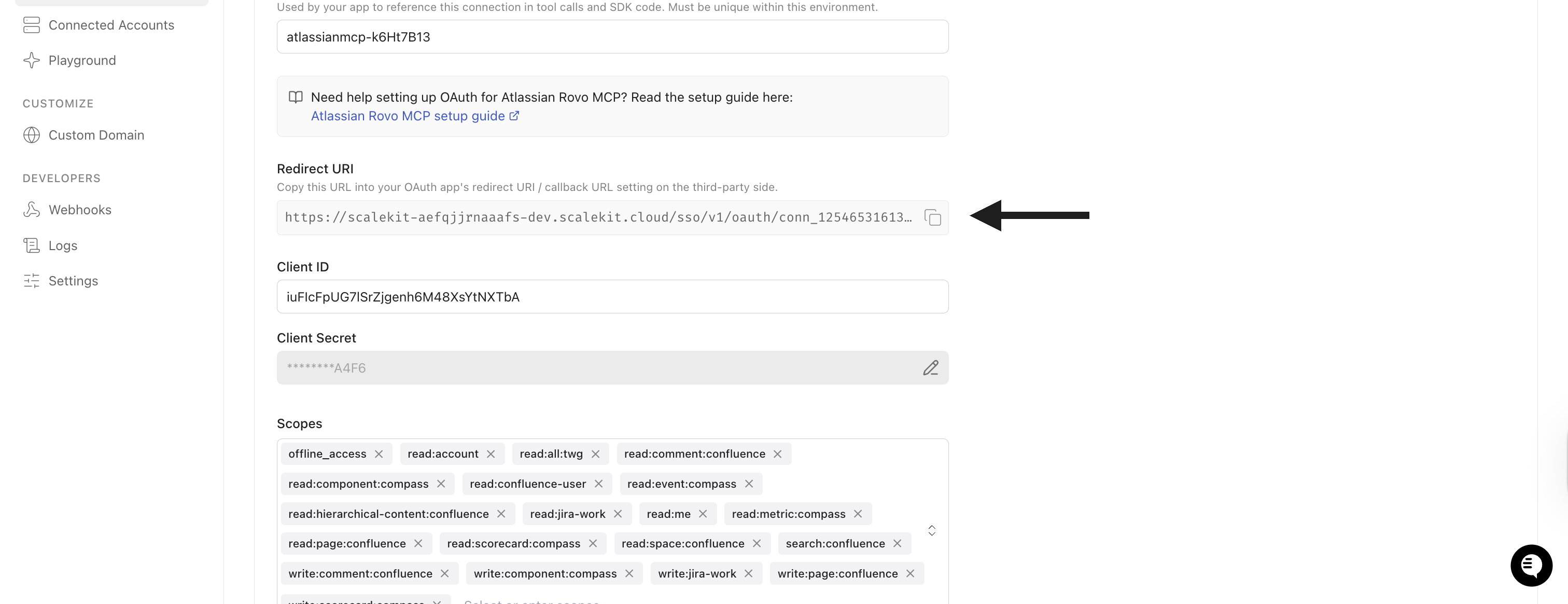
-
Open the Rovo MCP server settings in Atlassian
- Go to admin.atlassian.com and select your organisation.
- In the left sidebar, expand Rovo and click Rovo access.
- Click Rovo MCP server in the submenu.
- Select the Domains tab at the top of the page.
-
Add the redirect URI as a domain
- Under Your domains, click Add domain.
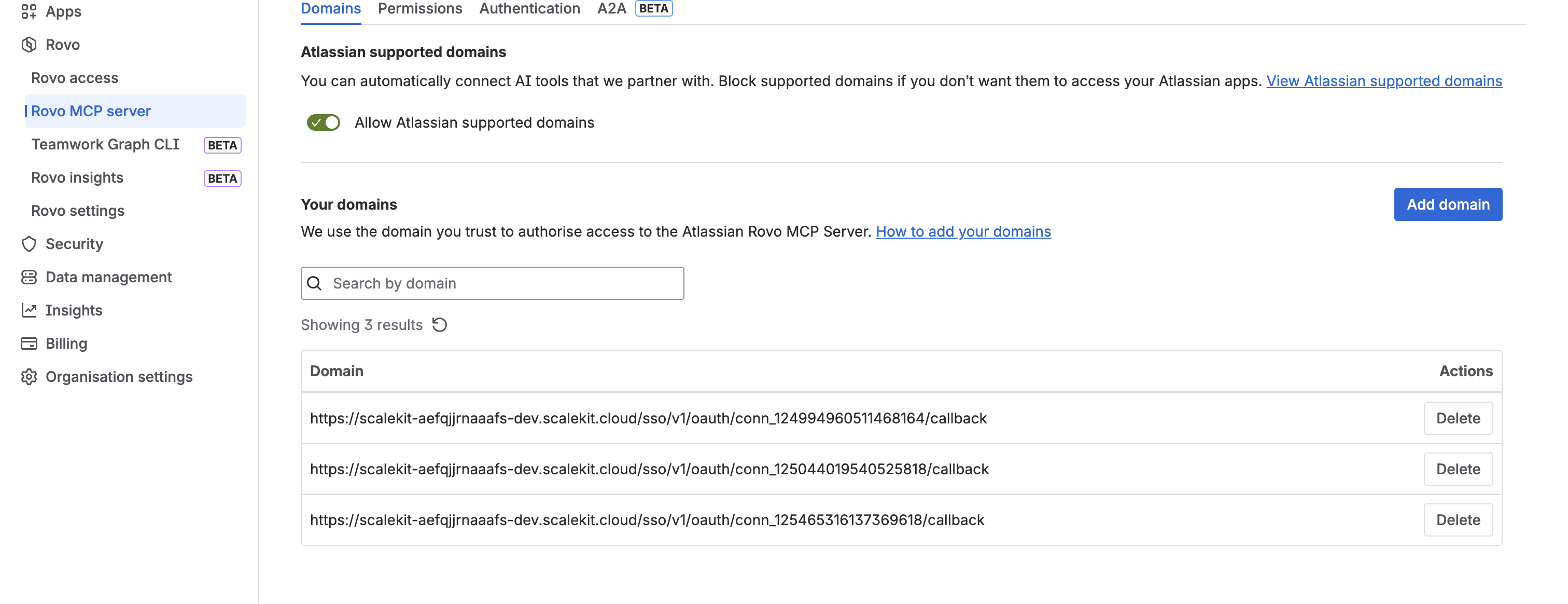
- In the Add domain dialog, paste the redirect URI from Scalekit into the Domain field.
- Accept the terms and click Add.
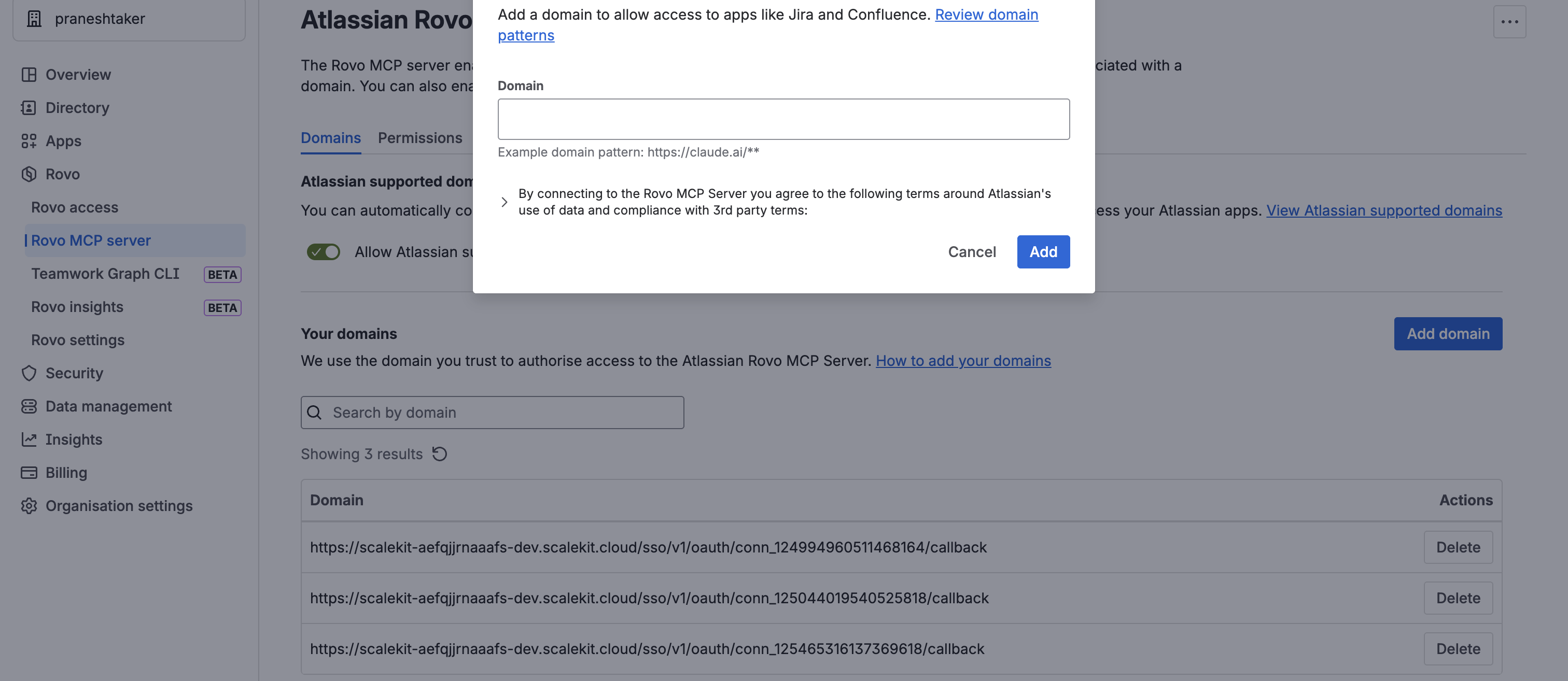
Once added, Scalekit automatically registers the OAuth client via DCR and handles token management for every user who authorizes the connection — no further configuration needed.
-
-
Authorize and make your first call
Section titled “Authorize and make your first call”quickstart.ts import { ScalekitClient } from '@scalekit-sdk/node'import 'dotenv/config'const scalekit = new ScalekitClient(process.env.SCALEKIT_ENV_URL,process.env.SCALEKIT_CLIENT_ID,process.env.SCALEKIT_CLIENT_SECRET,)const actions = scalekit.actionsconst connector = 'atlassianmcp'const identifier = 'user_123'// Generate an authorization link for the userconst { link } = await actions.getAuthorizationLink({ connectionName: connector, identifier })console.log('Authorize Atlassian Rovo MCP:', link)process.stdout.write('Press Enter after authorizing...')await new Promise(r => process.stdin.once('data', r))// Make your first callconst result = await actions.executeTool({connector,identifier,toolName: 'atlassianmcp_fetch',toolInput: { id: 'https://example.com/id' },})console.log(result)quickstart.py import osfrom scalekit.client import ScalekitClientfrom dotenv import load_dotenvload_dotenv()scalekit_client = ScalekitClient(env_url=os.getenv("SCALEKIT_ENV_URL"),client_id=os.getenv("SCALEKIT_CLIENT_ID"),client_secret=os.getenv("SCALEKIT_CLIENT_SECRET"),)actions = scalekit_client.actionsconnection_name = "atlassianmcp"identifier = "user_123"# Generate an authorization link for the userlink_response = actions.get_authorization_link(connection_name=connection_name,identifier=identifier,)print("Authorize Atlassian Rovo MCP:", link_response.link)input("Press Enter after authorizing...")# Make your first callresult = actions.execute_tool(tool_input={"id":"https://example.com/id"},tool_name="atlassianmcp_fetch",connection_name=connection_name,identifier=identifier,)print(result)
What you can do
Section titled “What you can do”Connect this agent connector to let your agent:
- Manage Jira issues — create, edit, transition, comment on, and link issues; add worklogs
- Search with JQL — query issues using Jira Query Language with full field and filter support
- Work with Confluence — create, update, and retrieve pages; add footer and inline comments
- Manage Compass components — create, get, and search services, libraries, and applications; define custom fields and relationships
- Look up users and resources — resolve Atlassian account IDs, list accessible cloud sites, and find project metadata
- Fetch Atlassian content — retrieve any Atlassian object by its ARI or URL (e.g. a Jira issue or Confluence page URL)
Common workflows
Section titled “Common workflows”Get your cloud ID
Most Atlassian Rovo MCP tools require a cloudId — the UUID that identifies your Atlassian cloud site. Call atlassianmcp_getaccessibleatlassianresources once to retrieve it, then pass the id field value in every subsequent tool call.
// Step 1 — get the cloud IDconst resources = await actions.executeTool({ connectionName: 'atlassianmcp', identifier: 'user_123', toolName: 'atlassianmcp_getaccessibleatlassianresources', toolInput: {},});const cloudId = resources[0].id;
// Step 2 — use cloudId in subsequent callsconst issue = await actions.executeTool({ connectionName: 'atlassianmcp', identifier: 'user_123', toolName: 'atlassianmcp_getjiraissue', toolInput: { cloudId, issueIdOrKey: 'KAN-1', },});console.log(issue);# Step 1 — get the cloud IDresources = actions.execute_tool( connection_name="atlassianmcp", identifier="user_123", tool_name="atlassianmcp_getaccessibleatlassianresources", tool_input={},)cloud_id = resources[0]["id"]
# Step 2 — use cloud_id in subsequent callsissue = actions.execute_tool( connection_name="atlassianmcp", identifier="user_123", tool_name="atlassianmcp_getjiraissue", tool_input={ "cloudId": cloud_id, "issueIdOrKey": "KAN-1", },)print(issue)The atlassianmcp_getaccessibleatlassianresources response looks like this:
[ { "id": "a4c9b3e2-1234-5678-abcd-ef0123456789", "name": "My Company", "url": "https://mycompany.atlassian.net", "scopes": ["read:jira-work", "write:jira-work", "read:confluence-content.all"] }]Use id as the cloudId parameter. If the user belongs to multiple Atlassian sites, the list contains one entry per site — pick the one matching the target url.
Tool list
Section titled “Tool list”Use the exact tool names from the Tool list below when you call execute_tool. If you’re not sure which name to use, list the tools available for the current user first.
atlassianmcp_addcommenttojiraissue#Add a comment to an existing Jira issue.6 params
Add a comment to an existing Jira issue.
cloudIdstringrequiredThe cloud site ID (UUID) of your Atlassian instance. Use getAccessibleAtlassianResources to retrieve it.commentBodystringrequiredThe text content of the comment to add.issueIdOrKeystringrequiredThe Jira issue ID (e.g. 10001) or key (e.g. KAN-1).commentVisibilityobjectoptionalRestrict comment visibility as JSON (e.g. {"type": "role", "value": "Dev Team"}).contentFormatstringoptionalFormat of the content body — use markdown for plain text or adf for Atlassian Document Format (JSON).responseContentFormatstringoptionalFormat to return content in — markdown (default) or adf.atlassianmcp_addworklogtojiraissue#Log time spent on a Jira issue by adding a worklog entry.8 params
Log time spent on a Jira issue by adding a worklog entry.
cloudIdstringrequiredThe cloud site ID (UUID) of your Atlassian instance. Use getAccessibleAtlassianResources to retrieve it.issueIdOrKeystringrequiredThe Jira issue ID (e.g. 10001) or key (e.g. KAN-1).timeSpentstringrequiredTime spent on the issue, in Jira duration format (e.g. 1h, 2h 30m, 1d).commentBodystringoptionalThe text content of the comment to add.contentFormatstringoptionalFormat of the content body — use markdown for plain text or adf for Atlassian Document Format (JSON).startedstringoptionalThe date and time the work started, in ISO 8601 format (e.g. 2026-05-15T10:00:00.000+0000).visibilityobjectoptionalRestrict worklog visibility as JSON (e.g. {"type": "role", "value": "Dev Team"}).worklogIdstringoptionalThe ID of an existing worklog entry to update.atlassianmcp_atlassianuserinfo#Retrieve the profile information for the currently authenticated Atlassian user.0 params
Retrieve the profile information for the currently authenticated Atlassian user.
atlassianmcp_createcompasscomponent#Create a new component in Atlassian Compass (e.g. a service, library, or application).6 params
Create a new component in Atlassian Compass (e.g. a service, library, or application).
cloudIdstringrequiredThe cloud site ID (UUID) of your Atlassian instance. Use getAccessibleAtlassianResources to retrieve it.namestringrequiredName of the Compass component.typeIdstringrequiredType ID of the Compass component (e.g. SERVICE, LIBRARY, APPLICATION).descriptionstringoptionalThe full description of the Jira issue.labelsarrayoptionalList of space labels to filter by.ownerIdstringoptionalAtlassian account ID of the component owner.atlassianmcp_createcompasscomponentrelationship#Create a dependency or relationship between two Compass components.4 params
Create a dependency or relationship between two Compass components.
cloudIdstringrequiredThe cloud site ID (UUID) of your Atlassian instance. Use getAccessibleAtlassianResources to retrieve it.fromComponentIdstringrequiredThe ID of the source Compass component in the relationship.relationshipTypestringrequiredThe type of relationship between components (e.g. DEPENDS_ON).toComponentIdstringrequiredThe ID of the target Compass component in the relationship.atlassianmcp_createcompasscustomfielddefinition#Define a new custom field for Compass components in your workspace.2 params
Define a new custom field for Compass components in your workspace.
cloudIdstringrequiredThe cloud site ID (UUID) of your Atlassian instance. Use getAccessibleAtlassianResources to retrieve it.inputobjectrequiredCustom field definition as JSON (fields: name, type, description).atlassianmcp_createconfluenceinlinecomment#Add an inline comment anchored to selected text on a Confluence page.7 params
Add an inline comment anchored to selected text on a Confluence page.
bodystringrequiredThe body content of the Confluence page or comment, in the format specified by contentFormat.cloudIdstringrequiredThe cloud site ID (UUID) of your Atlassian instance. Use getAccessibleAtlassianResources to retrieve it.contentFormatstringoptionalFormat of the content body — use markdown for plain text or adf for Atlassian Document Format (JSON).contentTypestringoptionalType of Confluence content: page, blogpost, or custom.inlineCommentPropertiesobjectoptionalInline comment anchor as JSON: {"textSelection": "<text>", "textSelectionMatchCount": N, "textSelectionMatchIndex": N}.pageIdstringoptionalThe numeric ID of the Confluence page. Use getConfluenceSpaces or search to find page IDs.parentCommentIdstringoptionalOptional ID of the parent comment, for creating a reply.atlassianmcp_createconfluencepage#Create a new Confluence page in a space, optionally nested under a parent page.10 params
Create a new Confluence page in a space, optionally nested under a parent page.
bodystringrequiredThe body content of the Confluence page or comment, in the format specified by contentFormat.cloudIdstringrequiredThe cloud site ID (UUID) of your Atlassian instance. Use getAccessibleAtlassianResources to retrieve it.spaceIdstringrequiredThe numeric ID of the Confluence space. Use getConfluenceSpaces to list available spaces.contentFormatstringoptionalFormat of the content body — use markdown for plain text or adf for Atlassian Document Format (JSON).contentTypestringoptionalType of Confluence content: page, blogpost, or custom.isPrivatebooleanoptionalSet to true to create the page as private (only visible to the creator).parentIdstringoptionalThe ID of the parent page under which to create or move this page.statusstringoptionalFilter by content status (e.g. current, archived, trashed).subtypestringoptionalConfluence page subtype (e.g. live for live pages).titlestringoptionalThe title of the Confluence page.atlassianmcp_createissuelink#Link two Jira issues together with a relationship type (e.g. Relates, Blocks, Duplicate).6 params
Link two Jira issues together with a relationship type (e.g. Relates, Blocks, Duplicate).
cloudIdstringrequiredThe cloud site ID (UUID) of your Atlassian instance. Use getAccessibleAtlassianResources to retrieve it.inwardIssuestringrequiredThe key of the inward issue in the link (e.g. KAN-1).outwardIssuestringrequiredThe key of the outward issue in the link (e.g. KAN-2).typestringrequiredSpace type filter (e.g. global or personal).commentstringoptionalAn optional comment to attach to the issue link.contentFormatstringoptionalFormat of the content body — use markdown for plain text or adf for Atlassian Document Format (JSON).atlassianmcp_createjiraissue#Create a new Jira issue in a project with the specified summary, type, and optional fields.11 params
Create a new Jira issue in a project with the specified summary, type, and optional fields.
cloudIdstringrequiredThe cloud site ID (UUID) of your Atlassian instance. Use getAccessibleAtlassianResources to retrieve it.issueTypeNamestringrequiredThe name of the Jira issue type (e.g. Task, Story, Bug, Epic).projectKeystringrequiredThe Jira project key (e.g. KAN). Use getVisibleJiraProjects to list available projects.summarystringrequiredA short summary of the Jira issue (the issue title).additional_fieldsobjectoptionalAdditional Jira fields to set on creation, as a JSON object (e.g. priority, labels).assignee_account_idstringoptionalAtlassian account ID of the user to assign. Use lookupJiraAccountId to find account IDs.contentFormatstringoptionalFormat of the content body — use markdown for plain text or adf for Atlassian Document Format (JSON).descriptionstringoptionalThe full description of the Jira issue.parentstringoptionalThe parent issue key (e.g. KAN-1) for creating subtasks or child issues.responseContentFormatstringoptionalFormat to return content in — markdown (default) or adf.transitionobjectoptionalThe transition to perform, as JSON: {"id": "<transition_id>"}. Use getTransitionsForJiraIssue to list valid transitions.atlassianmcp_editjiraissue#Update fields on an existing Jira issue, such as summary, priority, or description.5 params
Update fields on an existing Jira issue, such as summary, priority, or description.
cloudIdstringrequiredThe cloud site ID (UUID) of your Atlassian instance. Use getAccessibleAtlassianResources to retrieve it.fieldsobjectrequiredFields to update as a JSON object, e.g. {"summary": "New title", "priority": {"name": "High"}}.issueIdOrKeystringrequiredThe Jira issue ID (e.g. 10001) or key (e.g. KAN-1).contentFormatstringoptionalFormat of the content body — use markdown for plain text or adf for Atlassian Document Format (JSON).responseContentFormatstringoptionalFormat to return content in — markdown (default) or adf.atlassianmcp_fetch#Fetch details about any Atlassian object by its ARI (Atlassian Resource Identifier) or URL.2 params
Fetch details about any Atlassian object by its ARI (Atlassian Resource Identifier) or URL.
idstringrequiredAn ARI or URL identifying the object (e.g. ari:cloud:jira:...:issue/10059 or https://site.atlassian.net/browse/KAN-1).cloudIdstringoptionalThe cloud site ID (UUID) of your Atlassian instance. Use getAccessibleAtlassianResources to retrieve it.atlassianmcp_getaccessibleatlassianresources#List all Atlassian cloud sites accessible to the authenticated user, including their cloud IDs.0 params
List all Atlassian cloud sites accessible to the authenticated user, including their cloud IDs.
atlassianmcp_getcompasscomponent#Retrieve details of a specific Compass component by its ID.5 params
Retrieve details of a specific Compass component by its ID.
cloudIdstringrequiredThe cloud site ID (UUID) of your Atlassian instance. Use getAccessibleAtlassianResources to retrieve it.componentIdstringrequiredThe ID of the component to getincludeCustomFieldsInResponsebooleanoptionalSet to true to include custom field values in the component response.includeRelatedComponentsAndDependenciesInResponsebooleanoptionalSet to true to include related components and dependencies.includeRelatedLinksInResponsebooleanoptionalSet to true to include related links in the component response.atlassianmcp_getcompasscomponents#Search and list Compass components in a workspace, with optional filters.5 params
Search and list Compass components in a workspace, with optional filters.
cloudIdstringrequiredThe cloud site ID (UUID) of your Atlassian instance. Use getAccessibleAtlassianResources to retrieve it.afterstringoptionalCursor for fetching the next page of results.filtersobjectoptionalFilter criteria for Compass components as JSON (e.g. {"typeIds": ["SERVICE"]}).maxResultsnumberoptionalMaximum number of results to return per page.querystringoptionalSearch query to find Atlassian content across Jira and Confluence.atlassianmcp_getcompasscustomfielddefinitions#List all custom field definitions configured in a Compass workspace.1 param
List all custom field definitions configured in a Compass workspace.
cloudIdstringrequiredThe cloud site ID (UUID) of your Atlassian instance. Use getAccessibleAtlassianResources to retrieve it.atlassianmcp_getconfluencecommentchildren#Retrieve replies to a specific Confluence comment.7 params
Retrieve replies to a specific Confluence comment.
cloudIdstringrequiredThe cloud site ID (UUID) of your Atlassian instance. Use getAccessibleAtlassianResources to retrieve it.commentIdstringrequiredThe ID of the Confluence comment to retrieve children for.commentTypestringrequiredType of comment to retrieve children for: footer or inline.contentFormatstringoptionalFormat of the content body — use markdown for plain text or adf for Atlassian Document Format (JSON).cursorstringoptionalCursor string for paginating through results.limitnumberoptionalMaximum number of items to return.sortstringoptionalSort order for results (e.g. created-date, -modified, title).atlassianmcp_getconfluencepage#Retrieve the content and metadata of a specific Confluence page by its ID.4 params
Retrieve the content and metadata of a specific Confluence page by its ID.
cloudIdstringrequiredThe cloud site ID (UUID) of your Atlassian instance. Use getAccessibleAtlassianResources to retrieve it.pageIdstringrequiredThe numeric ID of the Confluence page. Use getConfluenceSpaces or search to find page IDs.contentFormatstringoptionalFormat of the content body — use markdown for plain text or adf for Atlassian Document Format (JSON).contentTypestringoptionalType of Confluence content: page, blogpost, or custom.atlassianmcp_getconfluencepagedescendants#List all pages nested under a Confluence page, up to a specified depth.5 params
List all pages nested under a Confluence page, up to a specified depth.
cloudIdstringrequiredThe cloud site ID (UUID) of your Atlassian instance. Use getAccessibleAtlassianResources to retrieve it.pageIdstringrequiredThe numeric ID of the Confluence page. Use getConfluenceSpaces or search to find page IDs.cursorstringoptionalCursor string for paginating through results.depthnumberoptionalHow deep to fetch descendants — all for the full tree or 1 for direct children only.limitnumberoptionalMaximum number of items to return.atlassianmcp_getconfluencepageinlinecomments#List inline comments on a Confluence page, optionally filtered by resolution status.11 params
List inline comments on a Confluence page, optionally filtered by resolution status.
cloudIdstringrequiredThe cloud site ID (UUID) of your Atlassian instance. Use getAccessibleAtlassianResources to retrieve it.pageIdstringrequiredThe numeric ID of the Confluence page. Use getConfluenceSpaces or search to find page IDs.contentFormatstringoptionalFormat of the content body — use markdown for plain text or adf for Atlassian Document Format (JSON).contentTypestringoptionalType of Confluence content: page, blogpost, or custom.cursorstringoptionalCursor string for paginating through results.includeRepliesbooleanoptionalWhether to include comment replies in the response (true or false).limitnumberoptionalMaximum number of items to return.repliesPerCommentintegeroptionalMaximum number of replies to include per comment.resolutionStatusstringoptionalFilter inline comments by resolution status (open or resolved).sortstringoptionalSort order for results (e.g. created-date, -modified, title).statusstringoptionalFilter by content status (e.g. current, archived, trashed).atlassianmcp_getconfluencespaces#List Confluence spaces accessible to the authenticated user, with optional filters.11 params
List Confluence spaces accessible to the authenticated user, with optional filters.
cloudIdstringrequiredThe cloud site ID (UUID) of your Atlassian instance. Use getAccessibleAtlassianResources to retrieve it.expandstringoptionalComma-separated list of fields to expand in the response.favoritedBystringoptionalReturn spaces favourited by this user account ID.favouritebooleanoptionalSet to true to return only spaces marked as favourite.idsstringoptionalList of space IDs to filter by.keysstringoptionalList of space keys to filter by.labelsstringoptionalList of space labels to filter by.limitnumberoptionalMaximum number of items to return.startnumberoptionalIndex of the first result for pagination (defaults to 0).statusstringoptionalFilter by content status (e.g. current, archived, trashed).typestringoptionalSpace type filter (e.g. global or personal).atlassianmcp_getissuelinktypes#List all available issue link types in a Jira instance (e.g. Blocks, Relates, Duplicate).1 param
List all available issue link types in a Jira instance (e.g. Blocks, Relates, Duplicate).
cloudIdstringrequiredThe cloud site ID (UUID) of your Atlassian instance. Use getAccessibleAtlassianResources to retrieve it.atlassianmcp_getjiraissue#Retrieve the details of a specific Jira issue by its ID or key.9 params
Retrieve the details of a specific Jira issue by its ID or key.
cloudIdstringrequiredThe cloud site ID (UUID) of your Atlassian instance. Use getAccessibleAtlassianResources to retrieve it.issueIdOrKeystringrequiredThe Jira issue ID (e.g. 10001) or key (e.g. KAN-1).expandstringoptionalComma-separated list of fields to expand in the response.failFastbooleanoptionalSet to true to fail fast if any fields cannot be found.fieldsarrayoptionalFields to update as a JSON object, e.g. {"summary": "New title", "priority": {"name": "High"}}.fieldsByKeysbooleanoptionalSet to true to reference custom fields by their keys instead of IDs.propertiesarrayoptionalList of issue properties to include in the response.responseContentFormatstringoptionalFormat to return content in — markdown (default) or adf.updateHistorybooleanoptionalSet to true to record that the issue was viewed in the user's history.atlassianmcp_getjiraissueremoteissuelinks#List remote links (external resources) attached to a Jira issue.3 params
List remote links (external resources) attached to a Jira issue.
cloudIdstringrequiredThe cloud site ID (UUID) of your Atlassian instance. Use getAccessibleAtlassianResources to retrieve it.issueIdOrKeystringrequiredThe Jira issue ID (e.g. 10001) or key (e.g. KAN-1).globalIdstringoptionalOptional global ID to filter remote issue links.atlassianmcp_getjiraissuetypemetawithfields#Retrieve field metadata for a specific Jira issue type in a project.5 params
Retrieve field metadata for a specific Jira issue type in a project.
cloudIdstringrequiredThe cloud site ID (UUID) of your Atlassian instance. Use getAccessibleAtlassianResources to retrieve it.issueTypeIdstringrequiredThe ID of the Jira issue type. Use getJiraProjectIssueTypesMetadata to list available types.projectIdOrKeystringrequiredThe Jira project ID or key (e.g. KAN or 10000). Use getVisibleJiraProjects to find it.maxResultsnumberoptionalMaximum number of results to return per page.startAtnumberoptionalIndex of the first result to return (for pagination, defaults to 0).atlassianmcp_getjiraprojectissuetypesmetadata#List all issue types and their field metadata for a Jira project.4 params
List all issue types and their field metadata for a Jira project.
cloudIdstringrequiredThe cloud site ID (UUID) of your Atlassian instance. Use getAccessibleAtlassianResources to retrieve it.projectIdOrKeystringrequiredThe Jira project ID or key (e.g. KAN or 10000). Use getVisibleJiraProjects to find it.maxResultsnumberoptionalMaximum number of results to return per page.startAtnumberoptionalIndex of the first result to return (for pagination, defaults to 0).atlassianmcp_getpagesinconfluencespace#List all pages in a Confluence space, optionally filtered by title or status.9 params
List all pages in a Confluence space, optionally filtered by title or status.
cloudIdstringrequiredThe cloud site ID (UUID) of your Atlassian instance. Use getAccessibleAtlassianResources to retrieve it.spaceIdstringrequiredThe numeric ID of the Confluence space. Use getConfluenceSpaces to list available spaces.contentFormatstringoptionalFormat of the content body — use markdown for plain text or adf for Atlassian Document Format (JSON).contentTypestringoptionalType of Confluence content: page, blogpost, or custom.cursorstringoptionalCursor string for paginating through results.limitnumberoptionalMaximum number of items to return.sortstringoptionalSort order for results (e.g. created-date, -modified, title).statusstringoptionalFilter by content status (e.g. current, archived, trashed).titlestringoptionalThe title of the Confluence page.atlassianmcp_getteamworkgraphcontext#Retrieve the teamwork graph context for an Atlassian object, showing related work across Jira, Confluence, and Compass.9 params
Retrieve the teamwork graph context for an Atlassian object, showing related work across Jira, Confluence, and Compass.
cloudIdstringrequiredThe cloud site ID (UUID) of your Atlassian instance. Use getAccessibleAtlassianResources to retrieve it.objectIdentifierstringrequiredIdentifier for the object — an issue key (e.g. KAN-4), ARI, or URL.objectTypestringrequiredType of the Atlassian object (e.g. JiraWorkItem, ConfluencePage, ConfluenceSpace, AtlassianUser, CompassComponent).afterstringoptionalCursor for fetching the next page of results.detailLevelstringoptionalLevel of detail to return for related objects (FULL or MINIMAL).firstintegeroptionalNumber of items to return in this page.relationshipTypesarrayoptionalFilter by specific relationship types (e.g. DEPENDS_ON, BLOCKED_BY).targetObjectTypesarrayoptionalFilter related objects by type (e.g. JiraWorkItem, ConfluencePage).timeRangeobjectoptionalOptional time range filter as JSON: {"from": "<ISO8601>", "to": "<ISO8601>"}.atlassianmcp_getteamworkgraphobject#Hydrate one or more Atlassian objects from their URLs or ARIs to get their current state.2 params
Hydrate one or more Atlassian objects from their URLs or ARIs to get their current state.
cloudIdstringrequiredThe cloud site ID (UUID) of your Atlassian instance. Use getAccessibleAtlassianResources to retrieve it.objectsarrayrequiredList of object URLs or ARIs to hydrate (e.g. https://site.atlassian.net/browse/KAN-1).atlassianmcp_gettransitionsforjiraissue#List all available workflow transitions for a Jira issue, used before calling transitionJiraIssue.7 params
List all available workflow transitions for a Jira issue, used before calling transitionJiraIssue.
cloudIdstringrequiredThe cloud site ID (UUID) of your Atlassian instance. Use getAccessibleAtlassianResources to retrieve it.issueIdOrKeystringrequiredThe Jira issue ID (e.g. 10001) or key (e.g. KAN-1).expandstringoptionalComma-separated list of fields to expand in the response.includeUnavailableTransitionsbooleanoptionalSet to true to include transitions that are not currently available.skipRemoteOnlyConditionbooleanoptionalSet to true to skip conditions that only apply to remote calls.sortByOpsBarAndStatusbooleanoptionalSet to true to sort transitions by the ops bar and status.transitionIdstringoptionalThe ID of a specific transition to retrieve. Use getTransitionsForJiraIssue to list transitions.atlassianmcp_getvisiblejiraprojects#List Jira projects visible to the authenticated user, with optional search filtering.6 params
List Jira projects visible to the authenticated user, with optional search filtering.
cloudIdstringrequiredThe cloud site ID (UUID) of your Atlassian instance. Use getAccessibleAtlassianResources to retrieve it.actionstringoptionalThe action to filter projects by (e.g. browse, create).expandIssueTypesbooleanoptionalSet to true to include issue type details in the project list response.maxResultsnumberoptionalMaximum number of results to return per page.searchStringstringoptionalText to search for when looking up Jira users.startAtnumberoptionalIndex of the first result to return (for pagination, defaults to 0).atlassianmcp_lookupjiraaccountid#Search for Atlassian user accounts by name or email to find their account IDs.2 params
Search for Atlassian user accounts by name or email to find their account IDs.
cloudIdstringrequiredThe cloud site ID (UUID) of your Atlassian instance. Use getAccessibleAtlassianResources to retrieve it.searchStringstringrequiredText to search for when looking up Jira users.atlassianmcp_search#Search across all Atlassian products (Jira and Confluence) using a keyword query.2 params
Search across all Atlassian products (Jira and Confluence) using a keyword query.
querystringrequiredSearch query to find Atlassian content across Jira and Confluence.cloudIdstringoptionalThe cloud site ID (UUID) of your Atlassian instance. Use getAccessibleAtlassianResources to retrieve it.atlassianmcp_searchconfluenceusingcql#Search Confluence content using Confluence Query Language (CQL).8 params
Search Confluence content using Confluence Query Language (CQL).
cloudIdstringrequiredThe cloud site ID (UUID) of your Atlassian instance. Use getAccessibleAtlassianResources to retrieve it.cqlstringrequiredConfluence Query Language string (e.g. type = page AND space = SD AND title ~ "meeting").cqlcontextstringoptionalOptional JSON object to restrict CQL scope (e.g. {"spaceKey": "SD"}).cursorstringoptionalCursor string for paginating through results.expandstringoptionalComma-separated list of fields to expand in the response.limitnumberoptionalMaximum number of items to return.nextbooleanoptionalInclude next page linkprevbooleanoptionalInclude previous page linkatlassianmcp_searchjiraissuesusingjql#Search for Jira issues using Jira Query Language (JQL).6 params
Search for Jira issues using Jira Query Language (JQL).
cloudIdstringrequiredThe cloud site ID (UUID) of your Atlassian instance. Use getAccessibleAtlassianResources to retrieve it.jqlstringrequiredJira Query Language string to filter issues (e.g. project = KAN AND status = "In Progress").fieldsarrayoptionalFields to update as a JSON object, e.g. {"summary": "New title", "priority": {"name": "High"}}.maxResultsnumberoptionalMaximum number of results to return per page.nextPageTokenstringoptionalToken for fetching the next page of results.responseContentFormatstringoptionalFormat to return content in — markdown (default) or adf.atlassianmcp_transitionjiraissue#Move a Jira issue to a new workflow status using a transition ID.6 params
Move a Jira issue to a new workflow status using a transition ID.
cloudIdstringrequiredThe cloud site ID (UUID) of your Atlassian instance. Use getAccessibleAtlassianResources to retrieve it.issueIdOrKeystringrequiredThe Jira issue ID (e.g. 10001) or key (e.g. KAN-1).transitionobjectrequiredThe transition to perform, as JSON: {"id": "<transition_id>"}. Use getTransitionsForJiraIssue to list valid transitions.fieldsobjectoptionalFields to update as a JSON object, e.g. {"summary": "New title", "priority": {"name": "High"}}.historyMetadataobjectoptionalOptional metadata to record in the issue history (e.g. {"activityDescription": "Updated via API"}).updateobjectoptionalIssue update operations as a JSON object (e.g. adding comment).atlassianmcp_updateconfluencepage#Update the title, body, or other properties of an existing Confluence page.11 params
Update the title, body, or other properties of an existing Confluence page.
bodystringrequiredThe body content of the Confluence page or comment, in the format specified by contentFormat.cloudIdstringrequiredThe cloud site ID (UUID) of your Atlassian instance. Use getAccessibleAtlassianResources to retrieve it.pageIdstringrequiredThe numeric ID of the Confluence page. Use getConfluenceSpaces or search to find page IDs.contentFormatstringoptionalFormat of the content body — use markdown for plain text or adf for Atlassian Document Format (JSON).contentTypestringoptionalType of Confluence content: page, blogpost, or custom.includeBodybooleanoptionalSet to true to include the page body in the update response.parentIdstringoptionalThe ID of the parent page under which to create or move this page.spaceIdstringoptionalThe numeric ID of the Confluence space. Use getConfluenceSpaces to list available spaces.statusstringoptionalFilter by content status (e.g. current, archived, trashed).titlestringoptionalThe title of the Confluence page.versionMessagestringoptionalOptional message describing what changed in this version of the page.